
Warenkorb
Es gibt keine Artikel mehr in Deinem Warenkorb
Research Compound
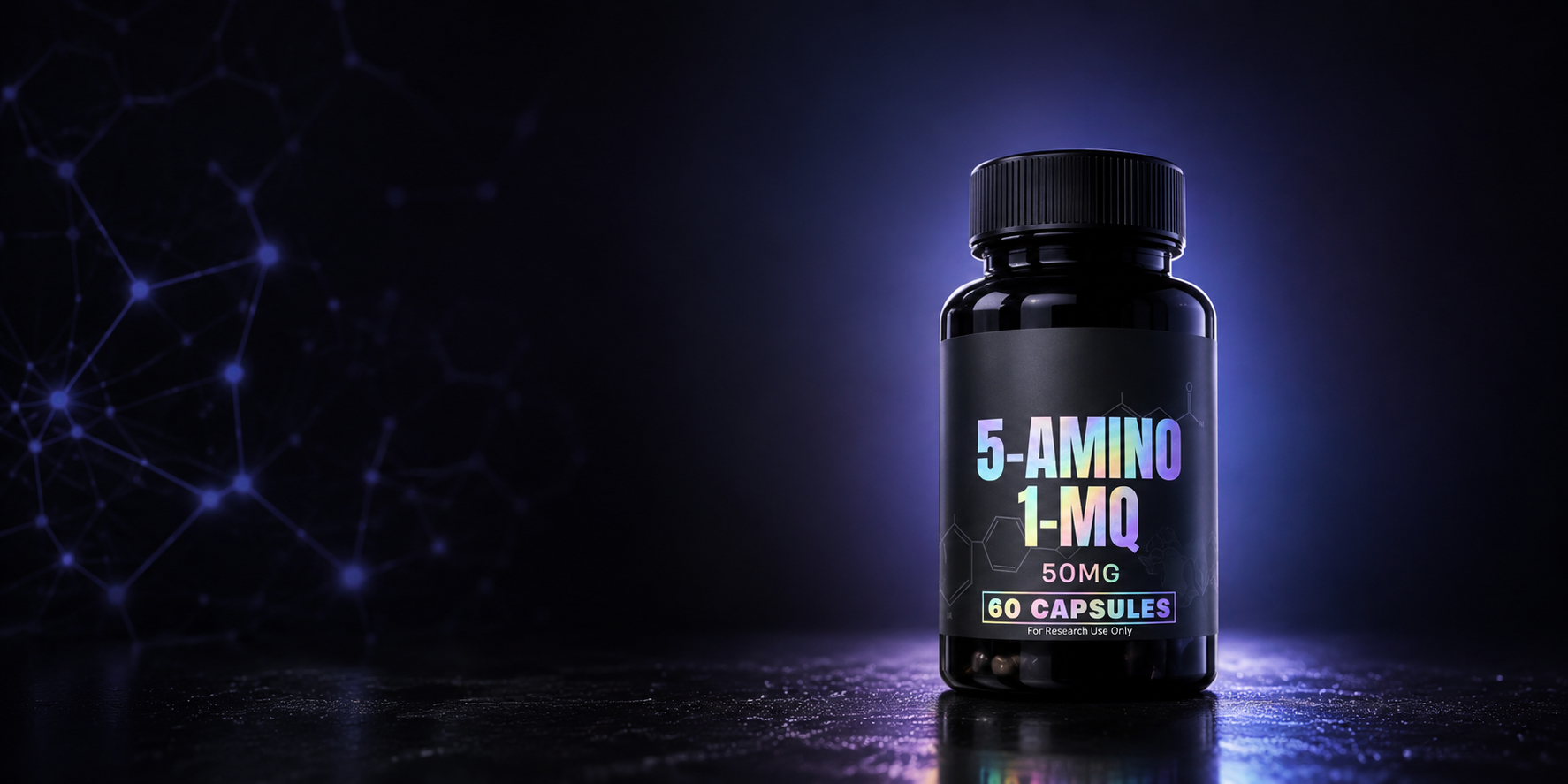
5-Amino-1MQ — a compound with not a single human in its evidence base
Few substances are described with this much confidence on this little data. The mechanism is elegant and biologically well founded. The entire body of evidence comes from cell culture and mouse experiments. A sober account of what has actually been studied.
Coach Claudio 10 min read Informational only
Before we start, so there is no misunderstanding
This article explains a research compound. It deliberately contains no dosages, no protocols and no usage recommendations — not out of caution, but because no basis for them exists. Anyone finding specific milligram figures online is reading forum lore and vendor copy, not study results.
At the centre sits an enzyme with an unwieldy name: nicotinamide N-methyltransferase, or NNMT. Its job sounds unremarkable — it attaches a methyl group to nicotinamide, producing 1-methylnicotinamide. What makes this interesting are two side effects.
First, nicotinamide is a starting material for the salvage pathway that recycles NAD, the central coenzyme of energy metabolism. Whatever NNMT methylates is no longer available for that recycling. Second, the methyl group comes from S-adenosylmethionine, the body's universal methyl donor. NNMT therefore consumes both NAD precursors and methylation capacity at the same time.
The pivotal finding arrived in 2014: in the fat tissue of severely obese humans and mice, NNMT is markedly upregulated. Switch the enzyme off in mice and the animals are protected against diet-induced obesity — while eating the same amount of food. That is a striking result, and it is the reason anyone went looking for inhibitors in the first place. 5-Amino-1MQ is one of them.
— The biochemistry behind it (tap to expand)
— Evidence by level
Three bars at zero — that is not a rendering error. There is no completed clinical trial of 5-Amino-1MQ in humans. No efficacy data, no safety data, no pharmacokinetics. Nobody has measured how much reaches the bloodstream after oral intake, how quickly it is cleared, or whether it reaches fat tissue at all.
That is what sets this apart from everything else covered on this blog. With creatine, the argument is about effect sizes drawn from hundreds of trials. With zinc, about absorption differences between salt forms. Here, the argument is about a hypothesis that worked in a mouse. Scientifically that is interesting, and commercially it has evidently been enough — but it is something entirely different from a proven compound.
— Four perspectives on the same compound
Cell culture: Inhibition of NNMT by this compound class is demonstrated and selective
Mouse model: In diet-induced obese mice, body weight and fat mass fell without the animals eating less
Genetic model: Knocking the enzyme out protects mice from becoming obese — the finding that started everything
Mouse model: In diet-induced obese mice, body weight and fat mass fell without the animals eating less
Genetic model: Knocking the enzyme out protects mice from becoming obese — the finding that started everything
The mouse work is well executed and the effect is clear. The problem is not the quality of those studies. It is that they stop at a different species.
No human trial of efficacy or safety
No pharmacokinetics: absorption, distribution, metabolism and excretion in humans are unknown
No dose-finding: the milligram figures in circulation have no origin in any study
No long-term data: NNMT is active in several tissues, not only fat — what sustained inhibition does elsewhere is an open question
No pharmacokinetics: absorption, distribution, metabolism and excretion in humans are unknown
No dose-finding: the milligram figures in circulation have no origin in any study
No long-term data: NNMT is active in several tissues, not only fat — what sustained inhibition does elsewhere is an open question
The most honest summary: it is not even known whether an oral dose reaches the target tissue in meaningful concentration.
1-methylnicotinamide is not waste. The molecule NNMT produces has biological activity of its own: anti-inflammatory, vasoactive, and it is released from skeletal muscle during exercise as a signalling molecule
Consequence: inhibiting NNMT also lowers it
Open question: whether the gain on the NAD side outweighs the loss on the signalling side is unresolved
Consequence: inhibiting NNMT also lowers it
Open question: whether the gain on the NAD side outweighs the loss on the signalling side is unresolved
This point is absent from virtually every article on the topic. It is the strongest substantive objection to the simple story that "less NNMT is better".
No drug approval in any country
Not an approved food additive and not a recognised supplement ingredient in Switzerland, the EU or the US
Competitive sport: the WADA Prohibited List explicitly covers, under category S0, any pharmacological substance with no current approval by a governmental health authority for human therapeutic use — 5-Amino-1MQ falls under it
Not an approved food additive and not a recognised supplement ingredient in Switzerland, the EU or the US
Competitive sport: the WADA Prohibited List explicitly covers, under category S0, any pharmacological substance with no current approval by a governmental health authority for human therapeutic use — 5-Amino-1MQ falls under it
For licensed athletes this is not a grey area. S0 applies at all times, in and out of competition.
— The evidence in numbers
Human trials0completed
Efficacy and safety
Evidence from0% animal and cell models
No clinical layer
Key paper0NNMT knockdown in mice
Origin of the interest
— Claim check
Common claim
Shown in mice
Obese mice lost fat mass with unchanged food intake. That is a clean result — in mice. This endpoint has never been examined in humans.
— How the knowledge developed
From 2011
NNMT enters the picture
Work shows the enzyme is more active in fat tissue in obesity and insulin resistance. Until then it was regarded as an unremarkable detoxification enzyme.
2014
The key paper
Silence NNMT in mice and the animals are protected from diet-induced obesity — on the same amount of food. The finding turns the enzyme into a drug target.
2017
The inhibitors appear
A research group describes selective, membrane-permeable small molecules that block NNMT. 5-Amino-1MQ is one of them — developed as a research tool, not as a product.
2018
The fat mass result
In animal work, the compound reduces body weight and fat mass in obese mice. This is the paper practically every sales page cites.
Since then
Standstill at the clinical level
The compound surfaced in the fitness and longevity market long before any clinical testing would have begun. The jump from mouse to shelf happened without the steps that normally sit in between.
⚖️ Ranked by strength of evidence
▼
| Compound | Target | Human trials | Status | Known risks |
|---|---|---|---|---|
| 5-Amino-1MQ | NNMT inhibition | None | Research compound | Unknown — never studied |
| NAD precursors (NR, NMN) | NAD repletion | Present | Supplement | Well tolerated, effect on hard endpoints unclear |
| Metformin | Hepatic glucose output, AMPK | Extensive | Approved medicine | GI effects, B12 lowering |
| Berberine | AMPK, insulin sensitivity | Moderate | Supplement | GI effects, many drug interactions |
| GLP-1 agonists | Satiety, gastric emptying | Extensive | Approved medicine | Nausea, well characterised profile |
| Creatine | Phosphocreatine stores | Extensive | Supplement | Very well studied |
What the table is getting at: the rows are not ordered by how well anything works, but by how much is known about it. A compound can look mechanistically more convincing than an established one and still sit at the bottom of the list — because nobody has checked whether the theory holds in humans. That is precisely where 5-Amino-1MQ sits.
What additionally applies to research compounds
Purity is unregulated. Research chemicals are not covered by the binding quality standards that apply to medicines or food. What is actually in a container is known only to someone holding an independent certificate of analysis matching that batch number.
Competitive sport: WADA category S0 covers any pharmacological substance with no approval by a governmental health authority for human therapeutic use. It applies at all times, not only in competition.
This page gives no usage recommendation and deliberately states no dosage. Anyone engaging with substances that have no human data is making a decision nobody else can make for them — and one for which no reliable guidance exists.
— Frequently asked
Because clinical trials are expensive, slow and regulatorily demanding. The route through the supplement market is shorter and cheaper — and nobody there has to speak to a regulator. A well-established mechanism in cell culture is no indication that clinical testing is planned, or that it would succeed. Most compounds that look convincing in animal models later fail in humans.
An enzyme that transfers a methyl group from S-adenosylmethionine onto nicotinamide. It is not confined to fat tissue — the highest levels are found in the liver, with further activity in adipose tissue, brain and other organs. That is one of the open issues: an inhibitor does not act only where you would like it to.
Because it was long considered a pure excretion product, and that turned out to be wrong. It has anti-inflammatory and vasodilatory properties and is released from skeletal muscle during exercise, where it takes part in regulating energy metabolism. Sustained NNMT inhibition lowers it. Whether that is an irrelevant side effect or a meaningful drawback is unresolved.
No, and the difference is fundamental. NMN and NR are building blocks that feed NAD precursors into the system. 5-Amino-1MQ is an inhibitor that blocks a disposal pathway. One tops up, the other closes a tap. NMN and NR have also been studied in humans — with mixed results as far as hard endpoints go.
Because those figures cite each other back and forth between vendor pages and forums. They do not originate in any published dose-finding work. The animal studies used quantities and routes of administration that do not translate directly into an oral capsule for humans. A number repeated often does not thereby acquire an evidence base.
No. WADA category S0 covers any pharmacological substance not approved by any governmental health authority for human therapeutic use. This applies whether or not the substance is named on a list, and it applies at all times — not only in competition.
Quiz — test your knowledge
What does NNMT, the enzyme this whole approach targets, actually do?
The bottom line in one sentence: 5-Amino-1MQ is a cleanly developed research tool for a biologically sound hypothesis — and it reached the fitness market before a single human had been studied with it. Anyone reading about it should know that distinction. Everything beyond that is an individual decision.
Prefer to work with what's proven?
The gap between an interesting mechanism and a compound that actually changes something for you is exactly where coaching begins. I build protocols from what has data — and say plainly where the data stops.
→ View coaching packagesQuestions? WhatsApp: +41 79 100 60 60
— Sources
- Kraus D. et al., Nature 2014 — NNMT knockdown protects mice against diet-induced obesity
- Neelakantan H. et al., Biochem Pharmacol 2017 — selective, membrane-permeable small molecule NNMT inhibitors
- Neelakantan H. et al., Biochem Pharmacol 2018 — NNMT inhibition and fat mass in the mouse model
- Ström K. et al., J Physiol 2018 — 1-methylnicotinamide as a muscle-derived signalling molecule during exercise
- Kannt A. et al., Diabetologia 2015 — NNMT expression in human adipose tissue and insulin resistance
- WADA Prohibited List, category S0 — non-approved substances
Coach Claudio — Sports Nutritions Switzerland
sports-nutritions.com
sports-nutritions.com